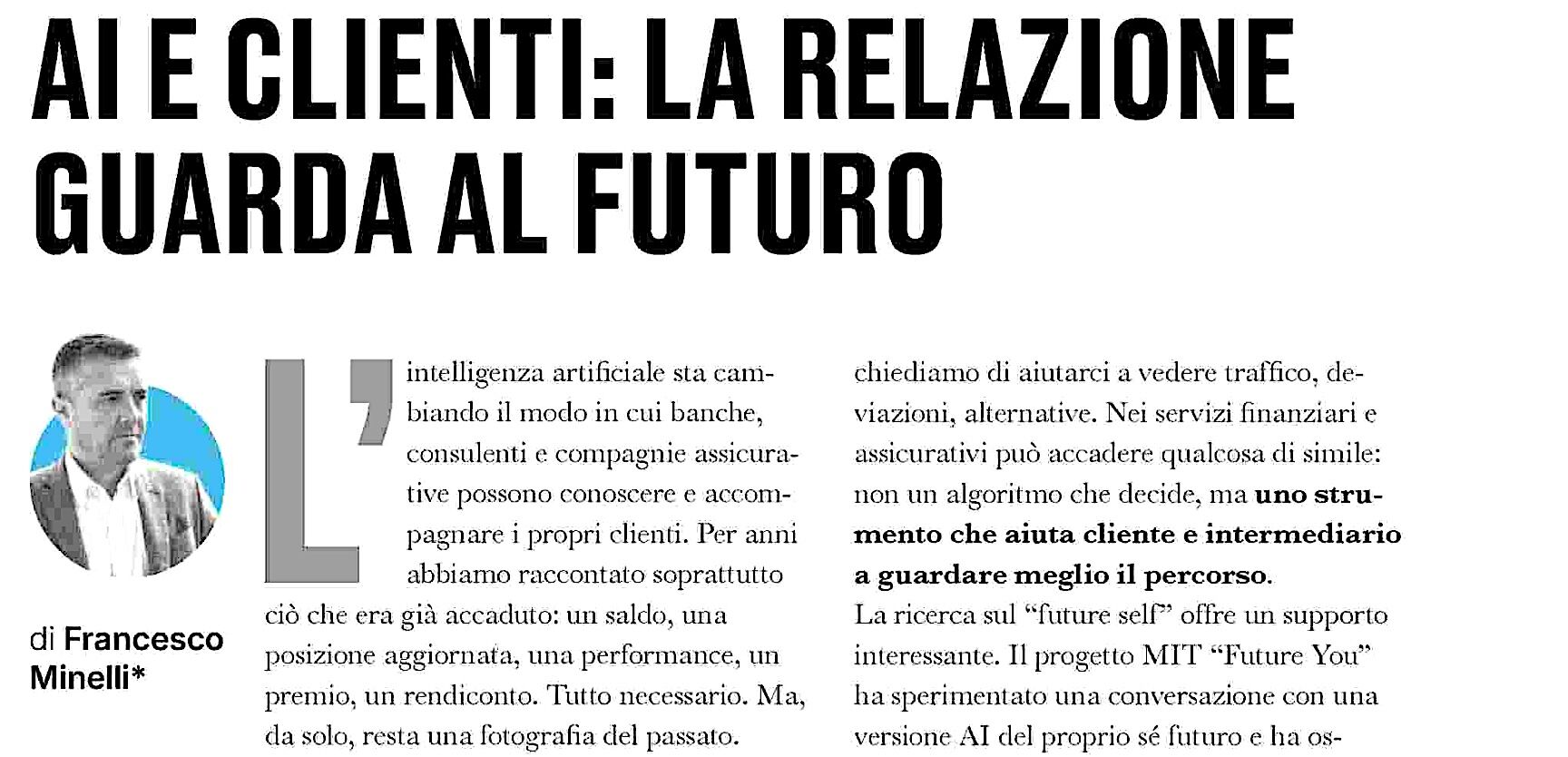
AI e clienti, la relazione guarda al futuro
By Francesco Minelli, Senior Advisor Insurance & Wealth Management at Excellence Consulting, for the monthly magazine Advisor
Artificial intelligence is changing the way banks, advisors, and insurance companies can understand and support their customers. For years, we have mainly reported what had already happened: an account balance, an updated position, a performance figure, an insurance premium, a statement. All necessary. But, on its own, this remains a snapshot of the past.
Today, technology allows us to take a different step: helping customers imagine where they might go. Not to predict the future. Not to generate anxiety. But to offer possible journeys and horizons: structured life scenarios, accompanied by proposals and solutions that help customers prepare with peace of mind.
From Statements to the Customer Journey
The point is not to overwhelm customers with difficult questions. Questions about the future often cause discomfort: How long will I live? Who will take care of me? Will I be able to maintain my lifestyle?
The real opportunity is to turn these questions into journeys. Not "what frightens you?" but "here are possible paths to make what you wish to protect or achieve more sustainable."
We can imagine a new form of forward-looking communication: not a statement of the past, but a map of future well-being. A representation of the journeys a person might go through: family, work, home, health, longevity, independence, care, generational transition, leisure time, postponed dreams. Not a list of risks, but a useful narrative of what can be prepared for.
When we use Waze, we do not ask the app to know the destiny of our lives. We ask it to help us see traffic, detours, and alternatives. Something similar can happen in financial and insurance services: not an algorithm that makes decisions, but a tool that helps customers and intermediaries see the path ahead more clearly.
Research on the "future self" offers interesting support. The MIT "Future You" project experimented with a conversation with an AI version of one's future self and observed a greater connection with the future and lower anxiety after the interaction. Studies by Hal Hershfield show that making one's future self more vivid can help people give greater weight to long-term decisions. When the future feels closer, it can become less threatening.
AI as a Compass, Not as a Pilot
This is where data and AI can become tools for greater awareness. They can help interpret trajectories, recurring events, weak signals, behaviors, and similar cases. They can help marketing departments identify emerging needs that would be difficult to detect from a central perspective. And they can provide bankers, advisors, and agents with a richer basis for useful, non-invasive conversations.
Imagine a young customer with a growing income but still limited assets held with a financial intermediary. Looking at this customer only through their account balance means failing to see their potential. Looking at them through their journey means recognizing their savings capacity, career trajectory, future home, income protection, family plans, and needs that will develop over time. The relationship must be nurtured before the need becomes apparent.
Imagine a family at the stage when children are growing up and parents are aging. A forward-looking map could show not only potential costs, but also gradual solutions: savings provisions, protection measures, periodic reviews, assistance services, and decisions to be prepared calmly.
Or consider a customer approaching retirement: not just "how much have you accumulated?" but "what quality of life do you want to make sustainable, what care expenses might you want to plan for, and what aspirations do you want to continue financing?"
The value of this communication lies in its tone. Not fear, but guidance. Not prediction, but scenarios. Not pressure, but a proposed path.
If the future is presented as a threat, customers withdraw. If it is presented as a possible journey, with stages and tools to navigate it, it can become easier to envision.
The Relationship Remains the True Competitive Advantage
And this is where a deeper form of loyalty can emerge. Not one built solely on economic conditions, habit, or inertia, but one that develops when customers feel supported through the important stages of their lives.
If a bank, an insurance company, an advisor, or an agent helps me see in advance what might become relevant, if they suggest possible paths without frightening me, if they help me protect what matters, then the nature of the relationship changes. It becomes a useful presence.
And in financial services, a useful presence at the right moments can become one of the strongest forms of loyalty.
Naturally, all of this requires responsibility. A map of the future must be explainable, authorized, prudent, and probabilistic. It must show possibilities, not verdicts. It must say "it might be useful to reflect on this," not "this will happen."
And it must leave room for the individual. Because those who manage the relationship understand nuances that no model can capture on its own: hesitations, unspoken dreams, family fears, desires for independence, the need for protection, pride, vulnerability, and trust built over time.
AI can provide a map. A person can turn it into meaningful support.
Perhaps the statement of the future will be a compass for personal well-being: not just "how much are your assets worth today?" but "which journeys do you want to prepare for, which dreams do you want to make sustainable, and which forms of protection can reduce uncertainty?"
Customers need someone who can help them imagine the future without fear, prepare for it methodically, and make it more sustainable.
Read all our contents