The channel that guides the life market and the new challenges of distribution
The in-depth analysis published by Insurance Review
Maurizio Primanni, CEO of Gruppo Excellence, e Bojan Petrovic, Senior Manager at Excellence Consulting, for Insurance Review
2025 closed at a record level and, after two difficult years, the sector returned to growth. Italian bancassurance confirms one key point: when it comes to life insurance policies, especially those linked to savings and investment, banks continue to be the channel that achieves critical mass and directs flows. In non-life insurance, on the other hand, branches do not dominate, but they are consolidating a specialist presence in areas with a strong affinity to the banking world, from credit to personal protection. This is a dynamic that, within commercial divisions, can be summed up in one word: integration. The policy is no longer just a standalone product, but part of the advisory and financial planning journey.
LIFE BUSINESS IS THE MAIN STRENGTH
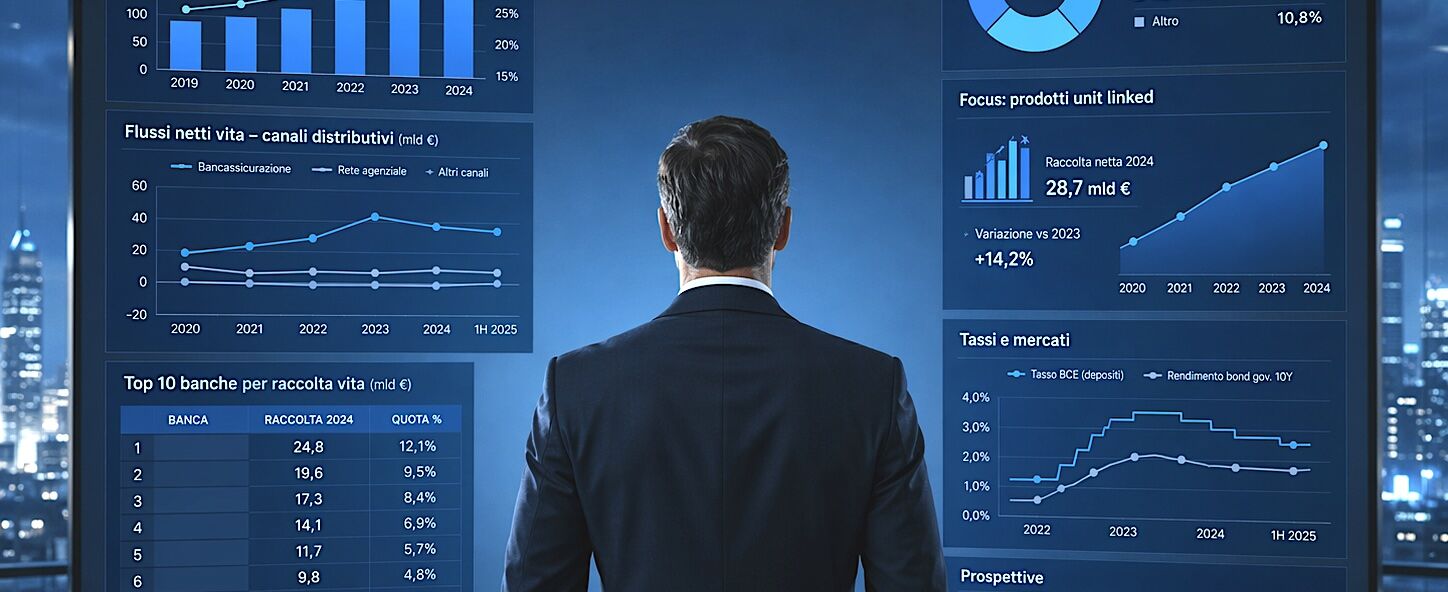
In 2025, the life insurance market reached €118.7 billion in gross written premiums, up 7.4% compared to the previous year (source: processing of ANIA data). The bancassurance channel grew faster than the market: bank and postal branches rose by 8.3% to €67.5 billion, while financial advisor networks recorded +8% to €20.1 billion.
Taken together, bank branches and financial advisor networks, with €87.6 billion in premiums, account for 73.8% of the life insurance market. A figure which, taken on its own, may seem like a confirmation, but actually portrays an industrial structure that, over five years, went through a crisis, emerged stronger, and accelerated beyond expectations. Looking at the 2020–2025 historical series, the bancassurance share fluctuates between 71% and 74%, showing remarkable resilience even during the difficult two-year period of 2022–2023. The rebound in 2024–2025 showed that the contraction had been cyclical: the model is holding up.
ADVISORY DRIVES HYBRID POLICIES
On the product side, Class I maintains its dominant position in bank branches, accounting for 69.3% of collections (€46.8 billion), while Class III accounts for 28.8% (€19.4 billion). In financial advisor networks, the proportions are reversed: Class III accounts for 62.5% of collections (€12.6 billion), compared with 34.8% for Class I (€7 billion).
The most significant figure for 2025 concerns hybrid products: they came close to €47 billion in premiums at total market level, with growth of 28.1% compared to 2024. Here too, bancassurance accounts for 76% (€35.6 billion), pushing banks and insurers to focus on advisory quality, clarity of positioning, and governance of the customer experience: hybrid products require solid processes, transparency, and the ability to manage them over time.
NON-LIFE MARKET: THE FRONTIER YET TO BE CONQUERED
While banks dominate the life segment, they still play only a marginal role in non-life insurance. The gap between these two figures — 73.8% in life and around 10.9% in non-life — represents one of the main strategic issues for the sector.
The Italian non-life market closed 2024 at €48.4 billion in premiums, up 7.9%, marking the sixteenth consecutive positive quarterly change. Bancassurance, driven almost exclusively by bank branches, established itself as the second channel with a 9.8% share, rising to 10.9% in the third quarter of 2025. The trend is clear: from 7.5% in 2022 to 10.9% in Q3 2025, more than three percentage points gained in less than three years.
However, the aggregate share masks a strong concentration. The banking presence is significant only where there is a financial or credit-related logic: pecuniary losses (39.4%), credit (38.6%), accident (23.4%), and health (21.1%). In lines that require traditional underwriting skills, such as fire, general liability, and above all motor third-party liability (more than 30% of the non-life market), the banking share remains marginal. In non-life insurance, bancassurance is not yet a structural stronghold, but rather a natural extension of lending activity.
THE CHALLENGE OF TOMORROW’S CLIENTS
Having 73.8% of the life insurance market today is an important result, but it also requires strategic reflection. The life savings product sold through bank branches to an already loyal customer base has become extremely efficient from a commercial standpoint, taking up much of the strategic reflection space. The risk is not that clients will be lost tomorrow, but rather that the sector may fail to be present in the customer segments that will matter the day after tomorrow. The generational transfer of wealth will affect Italy in particular, given the high stock of household wealth and the weight of real estate ownership. The beneficiaries of these transfers have a more fluid relationship with financial service providers, tend to spread their choices across several operators, and do not have the same bond with the local bank that characterized previous generations.
THE COMPETITION FROM ASSET MANAGERS
A competitor that bancassurance is watching with increasing attention is represented by major international asset managers. In recent years, some of the largest global managers have acquired European life insurance consolidation platforms or built proprietary annuity companies to integrate insurance capabilities into their value chain. This process is still at an early stage in Italy, but the direction appears clear: if the growth of Class III and hybrid products shows insurance moving closer to financial management, the response of large global asset managers appears symmetrical.
The risk for bancassurance is not losing the client, but seeing its role in the value chain compressed: for banks that distribute third-party products without controlling the management of the underlying assets, the entry of major global asset managers into insurance could reduce their bargaining power, transforming them from strategic partners of insurers into mere placement channels. This is a selective, not systemic, risk: it depends on who controls what along the chain. For this reason, it is worth monitoring.
Read all our articles